Why this line
The mini-plush blind box is the franchise’s “gateway” product: low cost, high frequency, and built for the impulse zone at the register.
Soft lines are the safest and fastest category to bring to retail — no tooling-heavy injection molds, no electronics, and a mature supplier base. A sealed surprise format adds a collect-and-trade mechanic that lifts units per transaction and repeat visits, while the metallic chase variant gives social and resale energy without changing the core BOM. This line proves the characters at retail and seeds demand for the higher-ticket figures, vinyl, and playset that follow.
Volume + awareness driver. Target the impulse / checkout lane and the kids’ collectible wall. Priced to be a “yes” without parent deliberation.
Look & feel
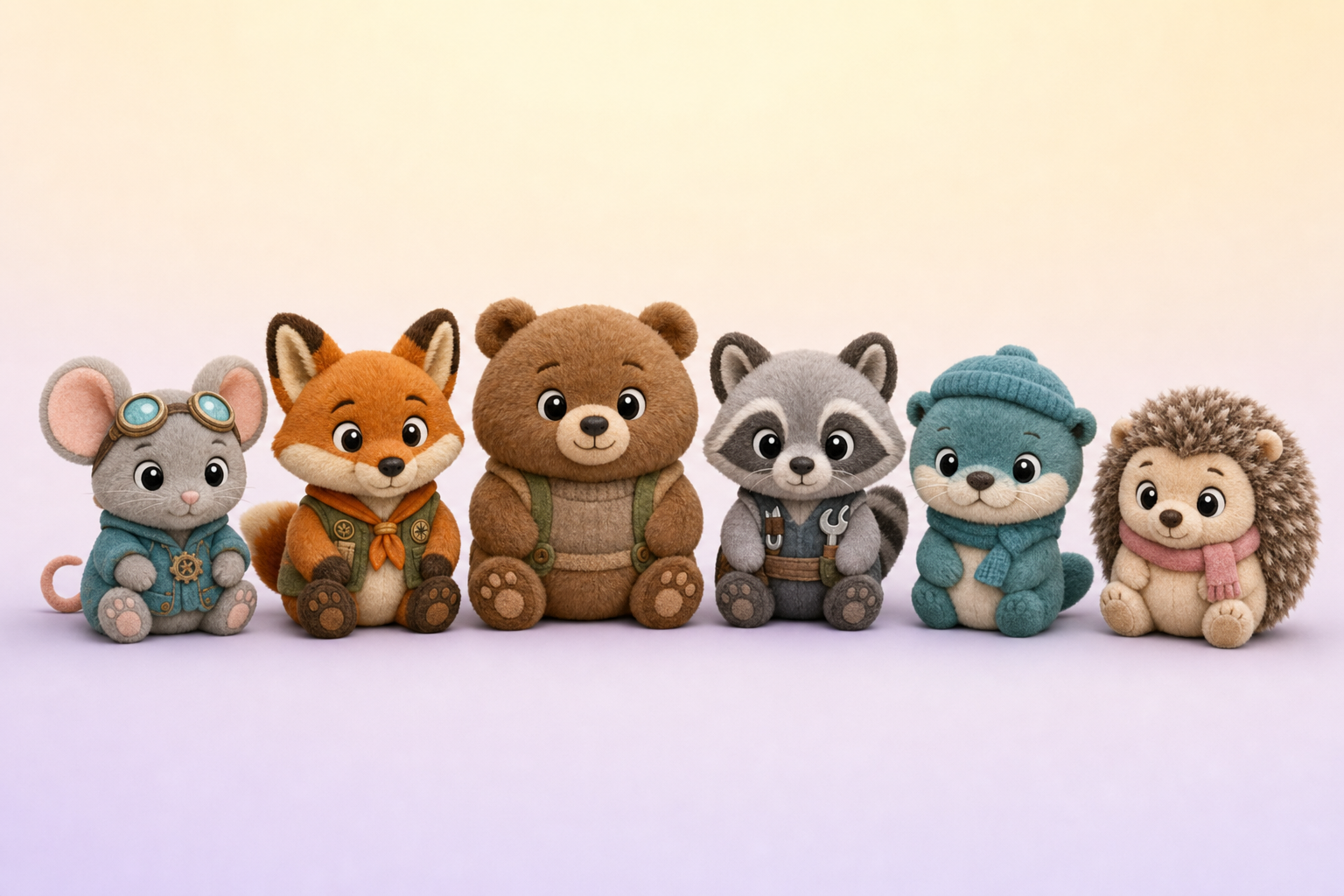
Each mini is a super-deformed (“chibi”) read of the hero: oversized head, simplified body, signature color and one or two iconic props rendered in stitch and applique rather than hard parts. The whole assortment must be instantly recognizable at thumbnail scale on a peg or in a bin, so silhouette and signature color do the heavy lifting.
- Big-head proportion (head ≈ 45–50% of total height) for shelf cuteness
- Embroidered faces only — no plastic safety eyes at this size
- One signature accessory per character (Flint’s goggles, Rowan’s scarf, Rivet’s wrench)
- Signature color hit visible from 2 m away
Turnaround art + Pantone call-outs per character (reuse the existing plush design sheets), a stitch/applique map, and a hangtag/character-card layout. Hand off as a 2D control art pack to the factory ID team.
Series 1 line-up
| SKU | Character | Signature color | Ratio |
|---|---|---|---|
| LC-MP1-001 | Flint (mouse) | Cyan | 2 / 24 |
| LC-MP1-002 | Rowan (fox) | Orange | 2 / 24 |
| LC-MP1-003 | Bruno (bear) | Brown | 2 / 24 |
| LC-MP1-004 | Rivet (raccoon) | Grey | 2 / 24 |
| LC-MP1-005 | Kai (otter) | Teal | 2 / 24 |
| LC-MP1-006 | Tumble (hedgehog) | Blush | 2 / 24 |
| LC-MP1-CH | Chase — metallic Flint | Gold foil fabric | 1 / 24 |
Standard inner is a sealed 24-count display tray (13 of each common at 2-per plus one chase). Ratios are tuned so a child can realistically complete the set across ~4–5 buys, with the chase rare enough to feel special.
Bill of materials
| Outer fabric | Super-soft polyester boa / minky, 230–260 gsm |
|---|---|
| Fill | Virgin PP fiber (face/body); PP plastic micro-pellets in base pod |
| Face | Computerized embroidery; no glued or hard components |
| Accessories | Applique + embroidery; felt scarf where used (sewn, not glued) |
| Thread | Polyester, color-matched; lockstitch seams |
| Inner bag | Sealed clear/foil polybag with vent hole and conformance warning print |
| Net weight | 40–55 g per piece (±10%) |
At this size everything is stitched or embroidered. No plastic eyes, no glued trims, no small detachable parts — this keeps the line clean for 3+ and simplifies safety testing.
From art to sealed tray
Lock control art & tech pack
Finalize turnarounds, Pantone/TPX color call-outs, stitch map and size spec for all 7 pieces. Issue a single bilingual tech pack to the factory.
Wk 0–2 · internalSource & approve fabrics
Pull lab dips and pile swatches; approve hand-feel and color under D65. Confirm the gold foil-fabric for the chase.
Wk 2–5 · factory + brandPattern & first sample (1st confirmation)
Factory drafts patterns and sews the first proto per SKU. Review proportion, face embroidery, seams; redline.
Wk 4–7Revised / pre-production sample (PPS)
Approve a sealed PPS that represents mass production. Sign the gold seal sample — the QC reference for the whole run.
Wk 7–10Safety & compliance testing
Submit PPS to an accredited lab (ASTM F963, EN 71-1/2/3, CPSIA, tracking label). Hold production until pass.
Wk 9–12 · 3rd-party labMass production & inline QC
Cutting → embroidery → sewing → stuffing → closing → blind-bag seal. AQL 2.5 inspection inline and at finishing.
Wk 12–18Random assortment & tray pack
Randomize to the published ratio, seal inner bags, pack 24-ct display trays and master cartons; barcode and label.
Wk 17–19Final inspection & shipment
Third-party final random inspection (AQL), then FOB. Plan ~30–45 day ocean transit to regional DCs.
Wk 19–20Surprise format + counter display
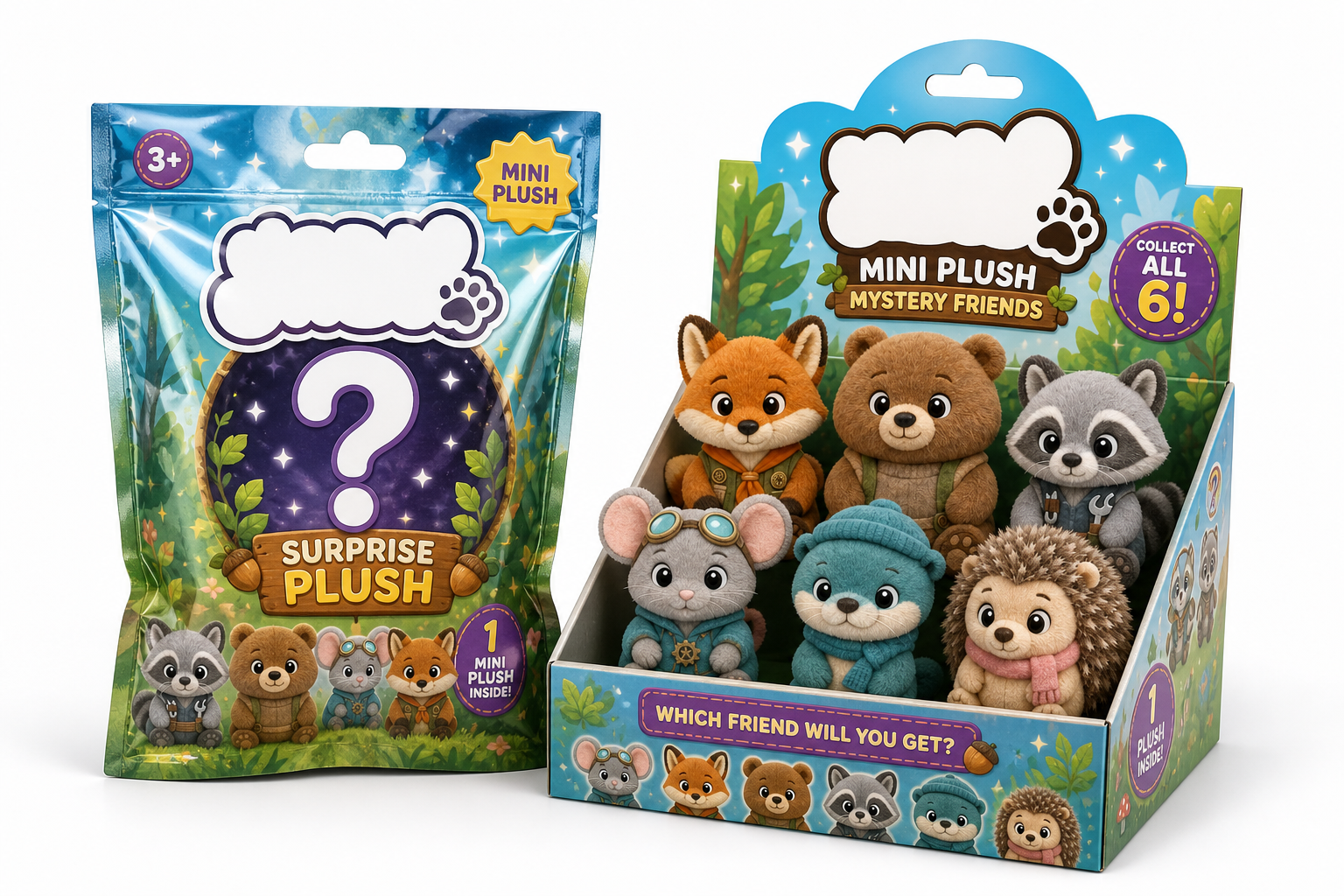
Two pack levels: a printed foil blind bag (single unit) and a PDQ display tray that doubles as the counter merchandiser. The bag front carries the “collect all 6” line-up, a mystery silhouette, age grade, and the metallic-chase tease.
- Opaque foil layer so the contents can’t be felt or seen
- “Collect all 6” checklist + chase callout
- PDQ tray ships flat-front, no extra labor to set
- Decide: recyclable mono-material bag vs. foil laminate
Blind-bag film is the program’s biggest waste flag. Evaluate a recyclable paper-based surprise wrap or mono-PE bag now, before tooling print plates.
Standards & testing
| US | ASTM F963; CPSIA (lead/phthalates), tracking label rule |
|---|---|
| EU / UK | EN 71-1 (mechanical), -2 (flammability), -3 (migration); UKCA + CE; REACH |
| Canada | Canada Consumer Product Safety Act / Toys Regulations |
| Key tests | Seam/tensile pull on all attachments, fiber cleanliness, small-parts (post age-grade), flammability |
| Age grade | 3+ (carries small-parts warning via the surprise bag; sold sealed) |
Embroidered faces and fully-sewn trims keep this line off the “small parts hazard” path. The polybag carries the standard suffocation warning and a vent hole.
Unit economics
| Target FOB cost | $1.05–$1.35 / unit (incl. bag) at MOQ |
|---|---|
| MOQ | ~3,000 pcs per character (Series 1 ≈ 18k–24k pcs total) |
| Landed cost (est.) | $1.55–$1.95 (duty + freight + warehousing) |
| Wholesale | $2.80–$3.20 |
| SRP | $6.99 |
| Tooling / NRE | Low — patterns, embroidery digitizing, print plates, samples |
Healthy keystone+ margin at retail with minimal upfront tooling. The chase variant adds perceived value at near-zero incremental cost. Numbers are planning estimates — confirm against live factory quotes.
Where it sells
Primary: mass and specialty toy (the collectible wall + checkout PDQ). Secondary: book fairs, theme-park and cinema lobby, and DTC multipacks on LittleCridders.com. The format is travel- and gift-friendly and pairs naturally with a film or streaming launch beat.
Phases & gates
Define
- Lock assortment + ratios
- Control art & tech pack
- Cost target sign-off
Sample
- Fabric / color approvals
- 1st → PPS samples
- Gold seal sign-off
Certify
- 3rd-party safety tests
- Packaging artwork final
- PO issued
Produce
- Mass production
- Inline + final AQL
- Random & tray pack
Ship & sell
- FOB & freight
- Retailer set
- Series 2 planning
Indicative timeline: ~5 months art-to-FOB for soft lines, the fastest path in the program.
Open items
- Confirm factory partner + live FOB quote against the cost model
- Decide sustainable bag material before print plates
- Approve chase mechanic + ratio with retail buyer
- Lock Series 1 vs. a later “allies” (Iris, Theo, Maya) Series 2