Why this line
The playset turns a collection of figures into a world. It’s the gift-list hero — the “big box” that defines the brand at retail and pulls through figure and accessory sales all year.
A great location playset is the highest-engagement toy a child can own: it’s the stage every figure wants to live on, and it justifies repeat purchases of characters, accessory packs, and expansion modules. It’s also the most complex and capital-intensive item in the program — many parts, multiple tools, real assembly — so it should follow the figures, reusing their scale and proving demand first.
Brand-defining hero + figure pull-through. Holiday centerpiece, gift-guide target, demo-able on shelf and in video.
The Great Oak, as a stage
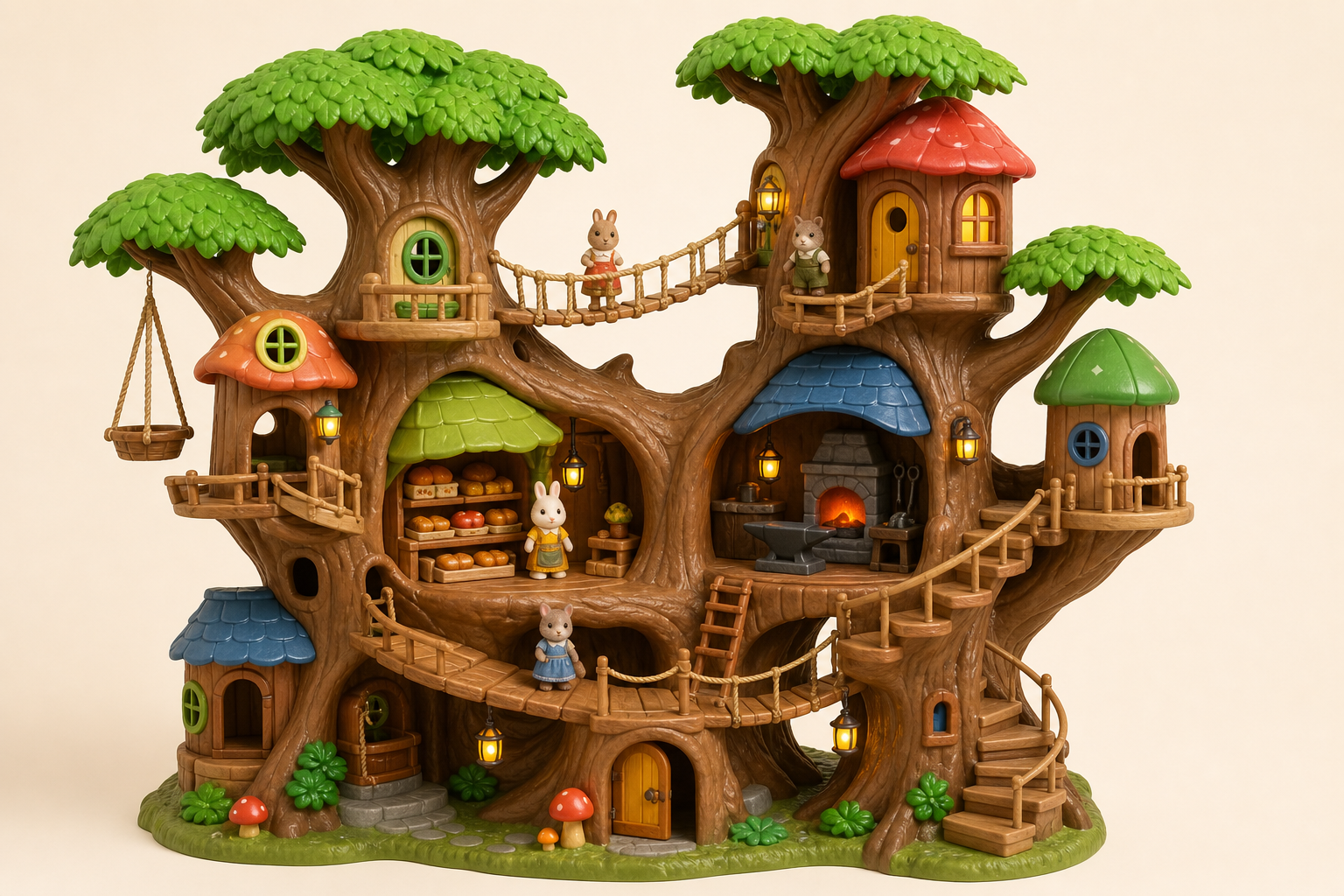
The set is the hollow oak from the treatment: a central trunk with two or three play levels, connected by rope bridges and ladders, with themed nooks (bakery, forge), working doors and windows, and lantern accents. Every surface should invite a figure to stand, sit, or hide. Play features — a working bucket lift, a swinging bridge, a launch or reveal gimmick — give it the “wow” demo a hero set needs.
- 2–3 play levels with figure-scale floors and pegs/footpegs
- At least 2–3 working features (bridge, lift, door/reveal)
- Modular: connects to future expansion modules
- Confirm assembled size vs. retail shelf + box-size limits
Concept maquette + CAD of the full set, play-feature mechanisms, parts breakdown, decoration/sticker sheet, assembly logic, and packaging dieline. Engineering-heavy — budget the most design time here.
Parts breakdown
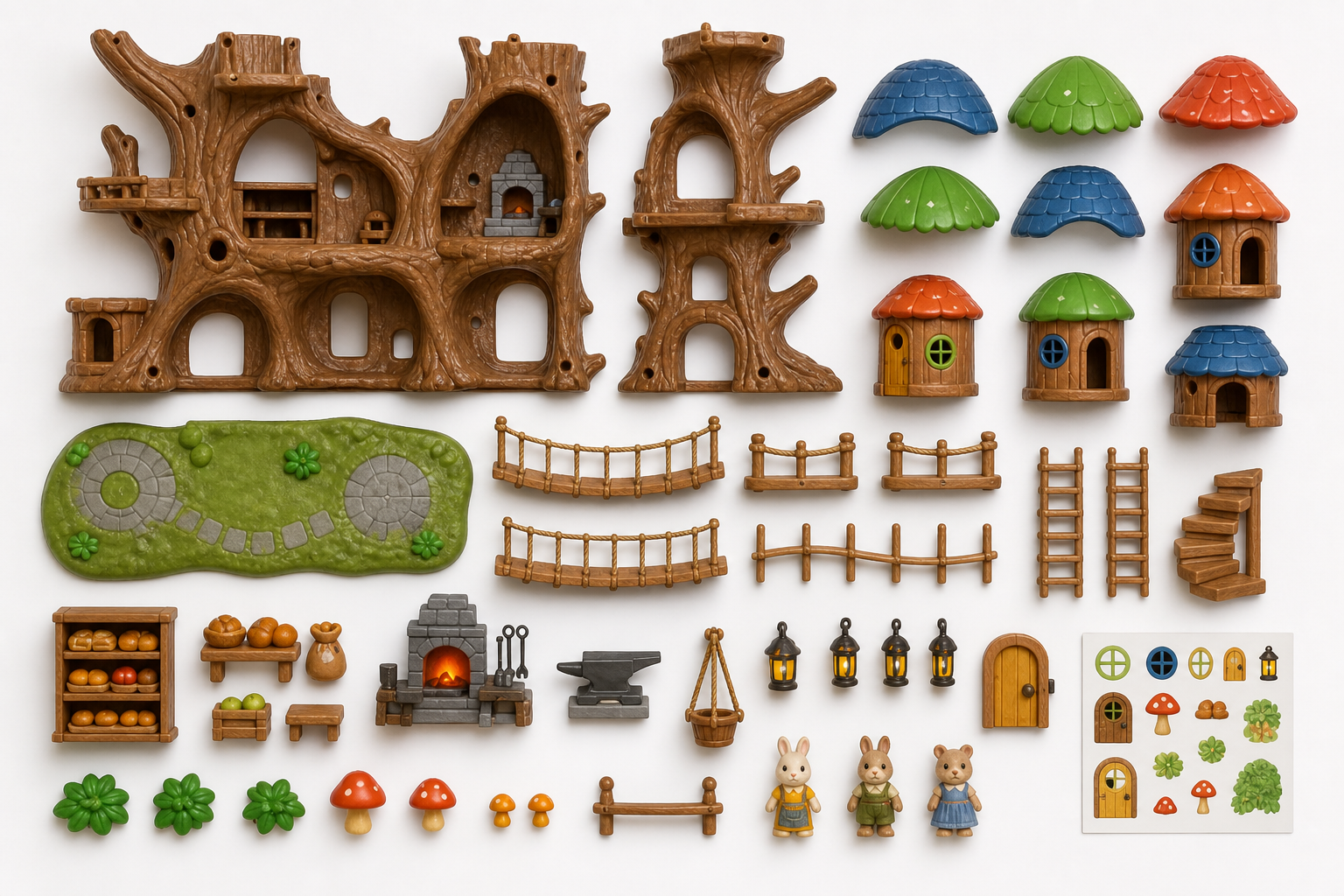
| Structure | Trunk halves + 2–3 platform levels (large blow-mold or injection parts) |
|---|---|
| Roofs / nooks | Mushroom-cap roofs, bakery + forge modules (injection) |
| Connectors | Rope bridges, ladders, spiral stair, fences |
| Play features | Working bucket lift, swinging bridge, reveal door |
| Accessories | Bread tray, anvil, lanterns, furniture, mushrooms, planters |
| Figures | 1–2 exclusive figures included (drives set value) |
| Decoration | Applied paint + sticker/decal sheet |
Bill of materials
| Large structure | Blow-molded HDPE for big hollow trunk parts (cost-efficient at size) |
|---|---|
| Detail parts | Injection ABS / PP for roofs, furniture, features |
| Flexible parts | Soft PVC / TPE for bridges, ropes |
| Fasteners | Snap-fit + a few tool-free screws; consumer assembly |
| Decoration | Spray + pad print on key parts; sticker sheet for detail |
| Net weight | ~1.5–2.5 kg assembled |
Mix processes by part size: blow-mold the big hollow forms, injection-mold the detail. Design for flat-ish nesting in the box and quick, tool-free consumer assembly with clear step art.
A tool family, not one mold
A playset is many parts and therefore many tools — large blow molds for the trunk shells plus multiple multi-cavity injection tools for detail parts and features. This is the largest tooling commitment in the program; lock the full parts list and assembly logic before cutting steel, because changes cascade across mating parts.
| Tool types | Blow molds (large parts) + injection family tools (detail) |
|---|---|
| Tools needed | Many — structure, roofs, features, accessories |
| Tooling cost (est.) | $80k–$180k+ total program (planning estimate) |
| Lead time | ~12–16 weeks to first full trial assembly |
From maquette to boxed hero
Concept maquette & CAD
Build a physical/CAD maquette of the full set, lock play features, scale to the figures, and break it into manufacturable parts.
Wk 0–10 · designMechanism & assembly prototyping
Prototype the working features (lift, bridge, reveal) and the consumer-assembly sequence; iterate for durability and ease.
Wk 8–16DFM across the parts family
Engineer every part for its process (blow vs. injection), wall, draft, mating tolerances, and snap-fits. Freeze the parts list.
Wk 14–20Cut tooling
Machine blow + injection tools in parallel. Critical path — sequence so trial assemblies can start as parts land.
Wk 20–36Trial shots & full assembly
T1 across all parts; build a complete set, verify fit, feature function, figure interaction, and assembly time; redline.
Wk 34–42Deco, PPS & gold seal
Lock paint + sticker sheet; approve a full pre-production set in final packaging with manual. Gold-seal sign-off.
Wk 42–46Safety & compliance testing
3rd-party lab: ASTM F963, EN 71, CPSIA; stability/load, feature durability cycling, pinch points, small parts.
Wk 45–49Mass production & pack-out
Mold → deco → kit + bag parts → insert manual + sticker sheet → master carton. Inline + final AQL.
Wk 49–60Final inspection & ship
3rd-party final random inspection; FOB. Land well ahead of the holiday window — it’s the long pole.
Wk 60–62Closed gift box, big shelf presence
A hero set ships in a closed printed gift box (not open-window) for damage protection and freight efficiency, with a large hero render, callouts for the working features and included figures, and an open-and-build promise. Parts nest with molded-pulp or paperboard inserts; the manual doubles as a play/story leaflet.
- Closed box with bold hero render + feature callouts
- “Includes 2 figures” flash for value
- Plastic-light inserts (molded pulp / paperboard)
- Optimize box cube for pallet / container efficiency
Standards & testing
| US | ASTM F963; CPSIA + tracking label |
|---|---|
| EU / UK | EN 71-1/2/3; CE / UKCA; REACH |
| Key tests | Stability / load, pinch & crush points on moving features, feature durability cycling, small parts, sharp edges |
| Age grade | 4+ likely; confirm via small-parts + feature assessment |
Moving features are the safety focus: design out pinch points, cap spring forces, and durability-cycle the lift/bridge to survive heavy play.
Unit economics
| Target FOB cost | $14–$22 (incl. 1–2 figures) |
|---|---|
| Tooling / NRE | $80k–$180k+ program (amortize over multi-year run) |
| MOQ | ~2,000–3,000 sets to amortize |
| Wholesale | $30–$45 |
| SRP | $59–$89 |
Largest investment and longest lead time, but a category-defining hero with strong figure pull-through. Greenlight after figures prove sell-through. Estimates for planning — validate with quotes + freight modeling (cube matters a lot here).
Phases & gates
Concept
- Maquette + CAD
- Play features
- Parts breakdown
Engineer
- DFM family review
- Freeze parts list
- Assembly logic
Tool
- Blow + injection tools
- Trial assemblies
- Feature validation
Certify + Produce
- PPS gold seal
- Safety testing
- Mass production
Holiday launch
- FOB early
- Gift-guide push
- Expansion modules
Indicative timeline: ~14–16 months art-to-FOB. Start it in parallel with the first figure wave to hit a holiday launch.
Open items
- Confirm figure scale + footpeg standard before set design (shared with the figures line)
- Lock 2–3 signature play features for the demo “wow”
- Set assembled-size + box-cube targets against retail and freight limits
- Decide included-figure count (set value vs. cost)
- Get blow + injection tooling quotes; model freight by cube